Since 2013, Donemus has made all of its scores and parts available digitally, alongside its traditional hard-copy offer. This was not done merely for reasons of efficiency, but also as part of a broader commitment to sustainability. By offering its catalogue of approximately 18,500 works as PDF and via Newzik, Donemus has sought to reduce paper use, limit physical transport, and support a more environmentally responsible circulation of music in an increasingly international market.
The ecological value of this strategy lies in two areas. The first is straightforward: digital delivery reduces the need to print and ship physical materials. The second is even more important. In international music publishing, transport may be a larger source of emissions than paper itself. A recent study on the carbon footprint of sheet music, prepared in the context of the Melbourne Symphony Orchestra, found that in a paper-based model the overwhelming majority of emissions came from shipping rather than printing. In that case, annual paper-based emissions were estimated at 4.18 tonnes of CO₂e, of which almost 4 tonnes resulted from shipping alone, and over six years 93.9% of the paper scenario was attributable to transport.
That finding is highly relevant for Donemus. Donemus serves a strongly international customer base, and digital availability therefore does more than save paper. It also reduces the need for repeated cross-border shipment of printed scores and parts. In other words, the environmental benefit of digital distribution is not only that fewer pages need to be printed, but also that fewer parcels need to be transported across borders. For a specialist publisher operating internationally, that is likely to be the more significant factor.
A reasonable indicative estimate suggests that a typical physical order may represent around 100 printed pages, equivalent to approximately 0.5 kg of paper. On that basis, the paper-related emissions avoided by digital fulfilment are modest but real. Yet the larger saving is likely to come from avoided shipping, especially where orders would otherwise be sent abroad. Using a cautious average calculation, the total avoided emissions per digitally fulfilled order can be estimated at roughly 2.0 to 2.2 kg CO₂e. Applied across Donemus’s annual webshop activity, this suggests that the current digital distribution model avoids approximately 3 to 4 tonnes of CO₂-equivalent emissions per year. This is not a full lifecycle assessment, but it provides a credible indication of the scale of the ecological benefit.
The Melbourne study also adds an important nuance. In a fully digital tablet-based environment, the principal carbon impact shifts from shipping to device acquisition: the study estimates the footprint of acquiring one new iPad at about 122.5 kg CO₂e, with the digital model becoming environmentally beneficial only after several years of use. That nuance matters, but it does not undermine the Donemus story. Donemus is not primarily arguing for the purchase of new devices; rather, it provides digital materials within an ecosystem in which many musicians, ensembles and institutions already use tablets or digital tools. The same study explicitly recommends allowing musicians to use devices they already own and concludes that digital material should be made available whenever requested.
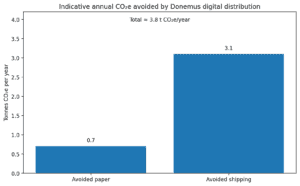 This makes the Donemus case particularly strong. Because the company has offered digital scores and parts since 2013, it has long enabled users to reduce the environmental burden of physical distribution without necessarily triggering a new wave of device purchases. In practice, that means the ecological benefit of Donemus’s digital strategy is closely tied to avoided logistics and reduced material throughput, rather than to a wholesale replacement of paper by newly manufactured hardware.
The broader conclusion is therefore clear. Donemus’s digital strategy should not be understood only as a paper-saving measure, important though that is. Its greater ecological significance lies in reducing the need for printing, packaging and, above all, international transport. By making all scores and parts digitally available since 2013, Donemus has not only modernised its services, but has also made a meaningful contribution to more sustainable music distribution. In that sense, its digital policy shows that accessibility, efficiency and environmental responsibility can go hand in hand.
Donemus and Sustainable Music Distribution on Spotify
Donemus and Sustainable Music Distribution on SoundCloud
Published 1 month ago